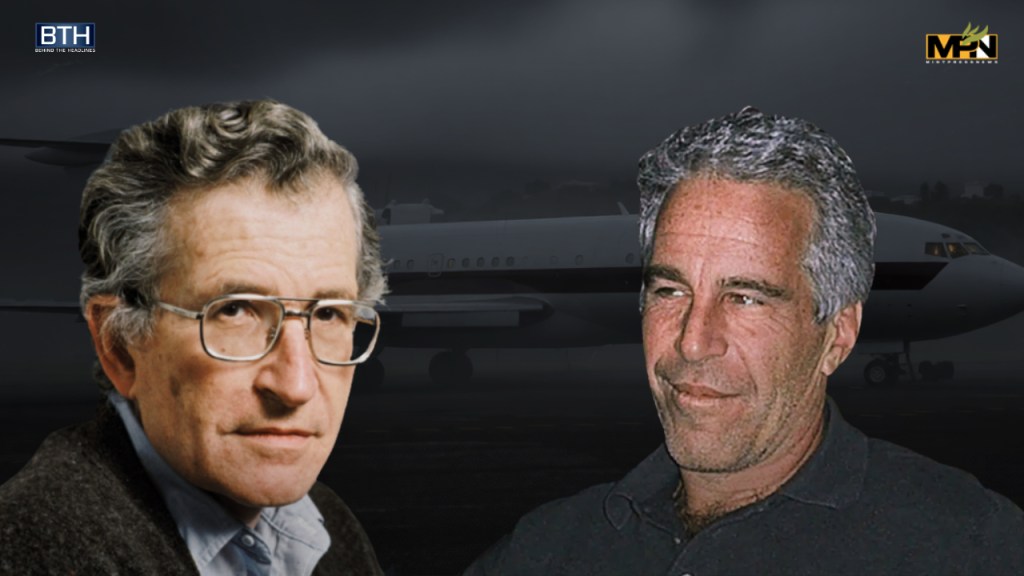
Newly released documents have shed light on the unlikely relationship between renowned leftist professor Noam Chomsky and disgraced pedophile Jeffrey Epstein
Author: Alan Macleod
6 Key findings of this investigation:
- Right up until his arrest for child sex trafficking, Chomsky was advising Epstein on crisis management, sympathizing with the “horrible way you are being treated in the press and public.”
- On multiple occasions, Chomsky expressed his desire to visit Little St. James Island, site of Epstein’s infamous sex crimes.
- Chomsky flew on Epstein’s “Lolita Express” jet, stayed at his mansions in Manhattan and Paris, and regularly met him for dinner and other social occasions.
- Chomsky quietly met with a host of other highly questionable characters, including Steve Bannon, Woody Allen, and Ehud Barak.
- Chomsky considered Epstein his “best friend,” and his closest advisor, and regularly exchanged gifts with the disgraced pedophile.
- Chomsky’s relationship with his children broke apart, due in part to their protests over his attempts to name Epstein’s accountant and right-hand man to the board of the family’s trust fund.
Newly released documents have shed light on the unlikely relationship between renowned leftist professor Noam Chomsky and disgraced pedophile Jeffrey Epstein. Analyzing over 3800 emails and texts involving the academic, MintPress News has uncovered a deep, years-long friendship between the two, one where they became “best friends” and each other’s closest confidants. Chomsky flew on Epstein’s notorious “Lolita Express” jet, stayed at his apartments in Manhattan and Paris, and expressed his desire, on multiple occasions, to visit Little St. James Island, the location of many of Epstein’s worst sex crimes.
Years of exchanging gifts and dining together – events that frequently included other highly controversial characters, such as disgraced filmmaker Woody Allen, far-right political strategist Steve Bannon, and former Israeli prime minister, Ehud Barak, turned the pair into the closest of friends. Chomsky became a key figure in Epstein’s attempts at crisis management, sharing his thoughts about strategies to quash and counter what he called “the onslaught of venomous attacks” against him. Meanwhile, Epstein became the star political philosopher’s trusted legal and financial advisor, a fact that would lead to a near collapse in the relationship between Noam and his children.
This is the story of the previously unknown relationship between the man who The New York Times called “the most important intellectual alive” and the world’s most infamous sexual predator.
Noam Chomsky: Jeffrey Epstein’s Crisis Manager
After 36 survivors – some as young as 14 – came forward, billionaire financier Jeffrey Epstein was convicted in 2008 on charges related to child sex crimes. He was, however, given only an 18-month sentence, and served only 13 months in a minimum security prison that he was allowed to leave six days per week. The U.S. attorney who struck this lenient deal reportedly stated that he did so under duress, and was told to “back off,” as Epstein “belonged to intelligence.”
Key to Epstein’s crimes becoming known was the testimony of his victim, Virginia Giuffre. Giuffre alleged that Epstein and his partner Ghislaine Maxwell operated a worldwide sex trafficking operation, where women and girls were kidnapped and forced to have sex with the world’s rich and powerful. This allegedly included royals like Prince Andrew, politicians such as Donald Trump and Bill Clinton, and academics, like Alan Dershowitz. Epstein reportedly made his fortune by keeping copious evidence of their sex crimes and extorting his clients. Previous Epstein Files releases have strongly indicated that Epstein, like Maxwell’s father and family, worked for Israeli intelligence.
The testimony from Giuffre and others sparked worldwide uproar, eventually forcing the U.S. government to act. In 2019, the FBI arrested Epstein, holding him in a high security Manhattan prison. Just weeks later, he was found dead in his cell, under highly suspicious circumstances.
Epstein was aware that the walls were closing in. Months before his arrest, he sent Chomsky a number of panicked emails, desperately asking for guidance on how to squash the widespread demands for his arrest.
On February 23, 2019, he wrote:
“Noam. I’d love your advice on how I handle my putrid press. Its is spiralling out of control. Do I have someone write an oped? Defend myself. Or try to ignore. Realizing that mobs are dangerous!”
“Can use some advice. The press is painting me as a monster. Congress, Senate being fed by plaintiffs. Lawyers only wanting money. I have no skill with the general public or media… Suggestions??” he asked another time.
Chomsky’s suggestion was generally to remain silent, hoping the situation would blow over. “Ive watched the horrible way you are being treated in the press and public. It’s painful to say, but I think the best way to proceed is to ignore it. I’ve had plenty of experience, though of course not on this scale,” he replied, adding that some of his close friends have also gone through the same thing.
“What the vultures dearly want,” he continued, “is a public response, which then provides a public opening for an onslaught of venomous attacks, many from just publicity seekers or cranks of all sorts.”
“Hard to say, but it’s the best advice I can think of,” he concluded, sympathizing with all the “torture and distress” the affair has caused. This is not a reference to the vast numbers of girls and women Epstein trafficked, abused, and raped, but to the mental anguish Epstein himself was going through, as his criminal network was being slowly and very publicly unraveled.
In his emails to Epstein, Chomsky denounced what he described as the “culture of gossip-mongers” destroying his stellar character. “These things have a half-life. The best reaction, I think, is to just stay above the furor, wait it out, go on with what matters.”
On December 29, 2018, Epstein asked his unofficial crisis manager for feedback on an op-ed article he wrote about himself in the third person, which he said he would send to The Washington Post and have published.
The fawning, saccharine piece presented Epstein as a near saint suffering outrageous slanders. As it read:
“The critics are wrong on the facts and the law. They also ignore a fact going to the heart of fundamental fairness: In the decade since paying his debt to society, Jeffrey Epstein has led a life characterized by responsible citizenship, numerous acts of generosity and good deeds. Here are the true key facts: Jeffrey Epstein [is] a successful self-made businessman with no prior criminal history whatsoever.”
It also stated that he “was treated exactly the same (including his time served) as any other state-incarcerated individuals,” for his 2008 conviction, a bizarre claim, considering his lenient sentence and conditions of incarceration.
Despite the fact that this was clearly a sock puppet article (a practice whereby an individual claims to be another entity in order to boost credibility), Chomsky was deeply impressed. “It’s a powerful and convincing statement,” he replied, although he once again advised against drawing even more media attention to the matter:
“Few are willing to think through the arguments and factual details or to try to adjudicate conflicting claims. I’ve seen this happen over and over on other matters… Ugly and bitter as it is, I suspect the best course now is not to stir the pot by raising the issue publicly, opening the door to charges and accusations that can no doubt be answered in the court of logic and fairness — but that’s not the public domain, where innuendo and suspicion and accusation reign.”
Chomsky suggested that, unfortunately, Epstein would simply have to “develop a thick skin” to “fend off whatever ugliness breaks through now and then.” “The great work that you have been doing speaks for itself,” he concluded, without explaining what exactly he was referring to.
Although the emails clearly show the extent to which Epstein trusted Chomsky, his intellect, and his judgment, he did not fully take his advice, and pursued a number of active measures to muddy the waters and improve his public image. One of these was to attempt to produce a documentary film about himself, presenting him in a good light. Epstein went into his Rolodex of influential people, calling in favors to see who would appear on camera endorsing him.
If his texts are to be believed, Chomsky was one of his most enthusiastic backers. “Spoke to Chomsky, he’s all in” he messaged an undisclosed associate in December 2018.
Epstein had leaned on Chomsky’s support previously. In 2017, he asked the professor to write a few paragraphs on why he continued to value his friendship for an article in Forbes magazine, the gist of which, according to Epstein, would be “why people still want his advice after all of his personal travails.” It appears that the article was never published.
Chomsky is often described as an “intellectual rock star,” or an “American Socrates.” The father of modern linguistics, he is more well known for his political work and activism, which has seen him become an icon of the left. First coming to public attention for his opposition to the Vietnam War, he has written in excess of 150 books on politics, social science, and the media.
His first wife, Carol, with whom he had three children, died in 2008. In 2014, he subsequently married Valeria Wasserman, a Brazilian translator 35 years his junior. He suffered a debilitating stroke in 2023, leaving him unable to speak or meaningfully converse. Until his final public appearances, however, he continued to defend Epstein, even after the latter was found dead in his cell.
In 2020, when asked about Epstein’s sex crime convictions, Chomsky was adamant: “There is a principle of Western law, that once a person has served a sentence, he is are the same as everybody else. It seems to be forgotten. Why this obsession but not with more significant characters?” he said, also attempting to deflect, noting that far worse people than Epstein regularly donate to his university, M.I.T.
One of his last interviews was with The Wall Street Journal, who questioned him directly about his connections to the disgraced billionaire. Chomsky was unusually blunt. “That is none of your business. Or anyone’s,” he stated, adding, “I knew him and we met occasionally.”
However, as this investigation will show, that is a self-serving and misleading description of an extremely close relationship forged over many years.
To be continued.
 Aleksandar Adzic