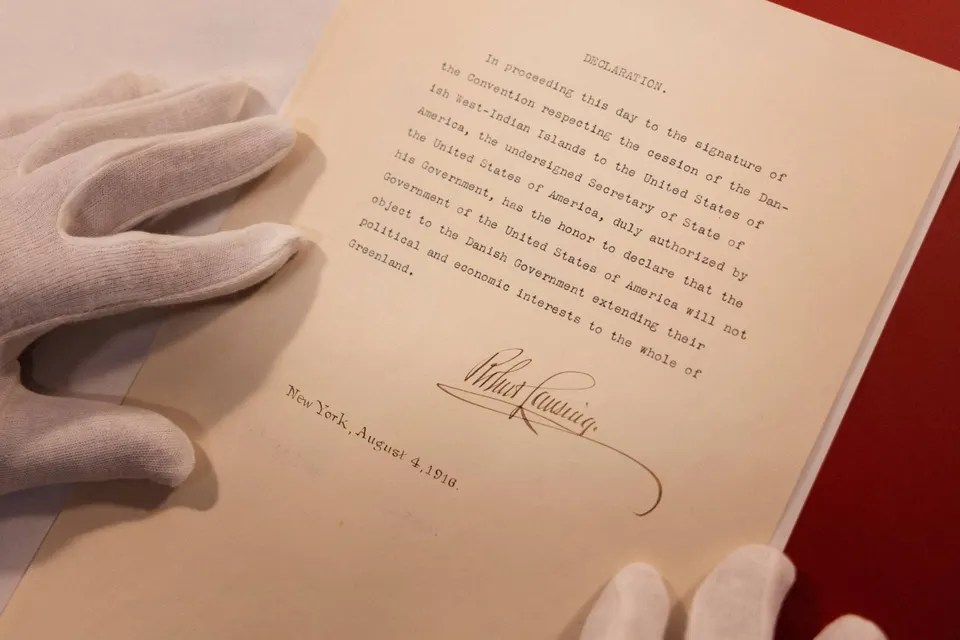
The 1916 “declaration” I am referring to is known as the Lansing Declaration (named after U.S. Secretary of State Robert Lansing). It was a diplomatic note issued on August 4, 1916, as part of the broader agreement for the United States to purchase the Danish West Indies (now the U.S. Virgin Islands) from Denmark.
This was not a direct exchange or trade of Greenland for Caribbean islands. Instead, it was a strategic diplomatic package driven by World War I concerns: The U.S. aimed to stop Germany from taking over the Danish West Indies (Saint Thomas, Saint John, and Saint Croix). This concern arose if Denmark were invaded or pressured during the war. Denmark, in turn, sought U.S. recognition of its claims over the entire island of Greenland. Danish presence had been expanding there but was not fully uncontested internationally.
Key Details of the 1916 Agreement
Main Treaty: The Convention between the United States and Denmark ceded the Danish West Indies. This was signed on August 4, 1916, in New York. The U.S. paid $25 million in gold. This was a huge sum at the time, equivalent to roughly $722 million today. This payment was for the islands.
The Transfer: The sale was finalized with the exchange of ratifications on January 17, 1917. The islands officially became U.S. territory on March 31, 1917 (still celebrated as Transfer Day in the U.S. Virgin Islands). The Lansing Declaration (the key “declaration” part): As a side agreement and precondition demanded by Denmark, Secretary Lansing formally stated:
“In proceeding this day to the signature of the Convention respecting the cession of the Danish West-Indian Islands to the United States of America, the undersigned Secretary of State of the United States of America, duly authorized by his Government, has the honor to declare that the Government of the United States of America will not object to the Danish Government extending their political and economic interests to the whole of Greenland.”
This declaration effectively gave U.S. diplomatic support to Denmark’s full sovereignty claims over Greenland, helping Denmark solidify control (which it formally declared in 1921). In return, Denmark agreed to sell the Caribbean islands.
It was a quid pro quo — the U.S. got a strategic Caribbean naval base/outpost, while Denmark received assurances about its Arctic territory amid wartime pressures.
Historical Context
- Denmark had long wanted to offload the unprofitable Danish West Indies.
- U.S. interest dated back decades. There were previous failed attempts in 1867 and 1902. However, urgency spiked in 1915–1916 due to fears of German expansion.
- Negotiations were secret to preserve Danish neutrality.
- The declaration helped pave the way for Denmark’s unchallenged claim to all of Greenland. This was despite some earlier Norwegian interests in the region.
This 1916 deal remains relevant today, especially in discussions about U.S. interest in Greenland (e.g., past proposals to buy it). Some sources note that recent U.S. statements on Greenland have been argued to violate the spirit of the Lansing Declaration.
In summary, there was no literal “swap” of territories, but the U.S. acquisition of the Caribbean islands was directly linked to American non-objection to Danish control over Greenland. This was a clever geopolitical bargain from the era of World War I.
 Aleksandar Adzic